
How long entry actually takes
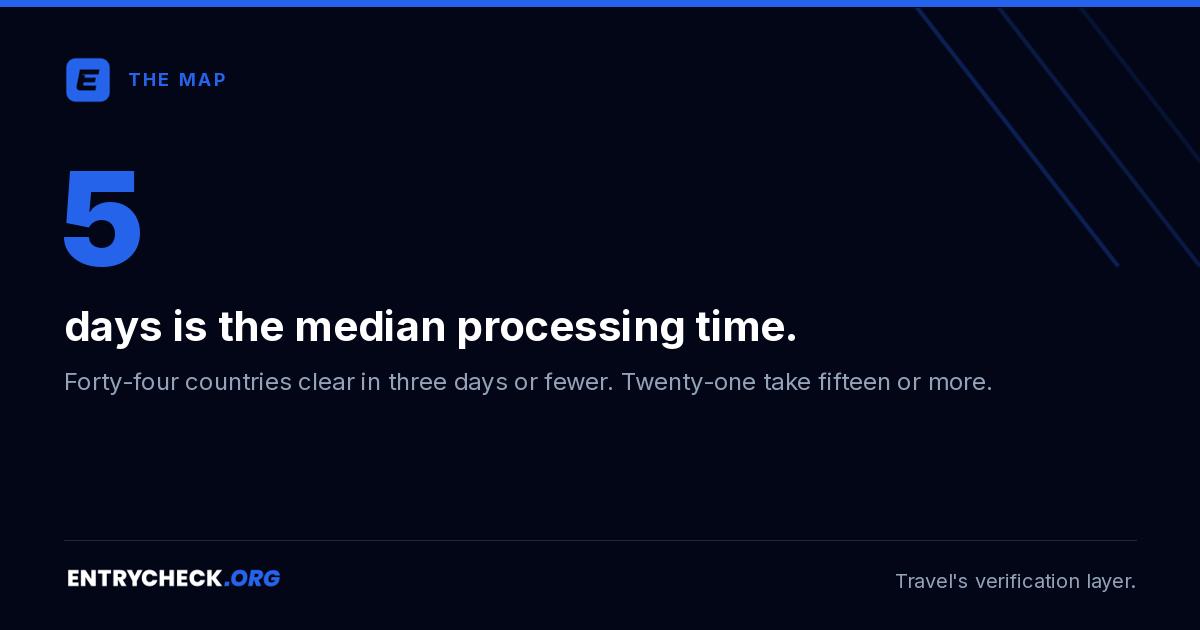
Across the registry, the median upper bound for processing a digital entry authorisation is five days. A third clear in three days or fewer. A handful still take a month.
Processing time is the number travellers actually care about, and it is the one least often published in a form you can compare. Each government states it differently: a range, a working-day figure, a promise with conditions attached.
We record what each portal states, in that portal's own terms. Read across the whole registry, a shape emerges.
The spread
Taking the upper bound of each stated range, the picture is:
- Median: five days. Half of all systems state an upper bound of five days or less.
- Forty-four countries clear in three days or fewer.
- Ninety-two clear within a week.
- Twenty-one state fifteen days or more.
Ten records state no processing time at all, usually because the system is new or the authority publishes none.
The fast end is faster than people expect
A small group operate at effectively zero. Qatar and Saudi Arabia quote instant issuance as the lower bound of their range. Jamaica and Palau state one day. Madagascar and Morocco state a window measured in hours rather than days.
This is the part that has changed most in a decade. The same journey once meant a consulate appointment, a passport handed over, and a wait measured in weeks. For a meaningful share of destinations it is now shorter than the time it takes to choose a hotel.
The slow end is not where you would guess
Four countries sit at thirty days: Belarus, Ukraine, Bangladesh and the United Kingdom.
The United Kingdom in that list surprises people, and it illustrates why the number needs reading carefully. A long upper bound does not mean a slow system. It means the authority has published a conservative ceiling covering its worst case, often across several visa categories of very different complexity. A country quoting three days may simply be quoting its simplest route.
This is the central difficulty with processing time as a metric. It is self-reported, it is not standardised, and the incentives do not pull in one direction. Some authorities quote optimistically to encourage applications. Others quote defensively to avoid complaints. Both are stating something true about their own system, and neither is comparable to the other without reading the conditions attached.
Why we publish it anyway
Because the alternative is worse. A traveller planning a trip needs some basis for deciding when to apply, and the authority's own stated figure, recorded faithfully and dated, is the most defensible basis available. We do not average it, adjust it or convert it into a rating. We state what the portal states, and we record when we last checked.
What it means for anyone building on this
If you are putting processing time in front of a user, two things follow from the shape above.
Treat the number as a ceiling and not a promise, because that is what most authorities intend by it. And never cache it. Twenty-one countries sit in the range where a change of a few days materially alters when someone should apply, and processing times move when volumes move, which is seasonal in most of the world.
Figures taken from the EntryCheck registry. Each country page states that country's processing time in the authority's own terms, with the date a person last confirmed it.
EntryWire
Every eVisa, eTA and entry-rule change that matters, each with the official government portal. Free, weekly.
Check your inbox, a welcome from EntryWire is on its way.
EntryCheck does not decide whether you need a visa or an authorisation. Confirm your own requirements with the official government source for your destination.